
If your swing feels inconsistent, weak, or out of control, you don’t need a complete rebuild you need solid golf swing basics. This guide walks you through the core fundamentals step by step so you can build a repeatable, powerful swing that actually holds up on the course.
The 7 core fundamentals of a basic golf swing
Every good golf swing no matter the style rests on the same core pieces:
- Grip: How you hold the club
- Setup & stance: Alignment, ball position, and width
- Posture: Spine angle and athletic tilt
- Takeaway: How the club starts back
- Backswing: Turning around a stable base
- Downswing & impact: Sequence, rotation, and strike
- Follow-through: Balanced, controlled finish
What you’ll learn in this guide
- How to grip the club in a way that matches your swing and ball flight
- How to set up with the right stance width, ball position, and alignment
- How to build a solid posture that lets you turn instead of sway
- How to start the swing with a simple, repeatable takeaway
- How to rotate in the backswing and downswing without losing balance
- How to make solid contact more often with irons and driver
1. Golf grip basics
Your grip is the only connection between you and the club. A poor grip makes the rest of the swing much harder than it needs to be.
Neutral grip checklist
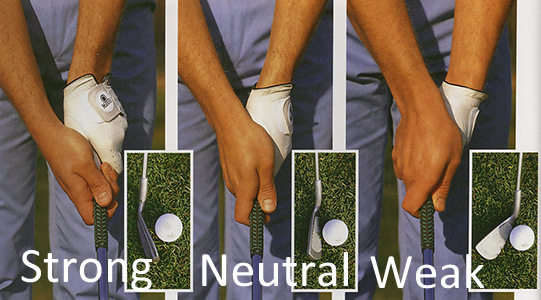
- Lead hand (left hand for right-handed golfers): Place the club in the fingers, not the palm. When you look down, you should see about 2–3 knuckles.
- Trail hand: Fits over the lead thumb, more in the fingers than the palm, with the “V” between thumb and index pointing between your trail shoulder and chin.
- Grip pressure: Firm enough to control the club, light enough that your forearms aren’t tense, about a “4–5 out of 10.”
Common grip mistakes
- Too weak: Lead hand too far turned toward the target → often leads to slices and weak contact.
- Too strong: Lead hand too far under the club → can cause hooks and low, diving shots.
- Too much in the palm: Limits wrist hinge and power.
Quick tip: If you struggle with a slice, a slightly stronger grip (seeing 3 knuckles instead of 2) can help you square the face more easily.
2. Setup and stance basics
A good swing starts before the club moves. Your setup creates the conditions for a solid, repeatable motion.
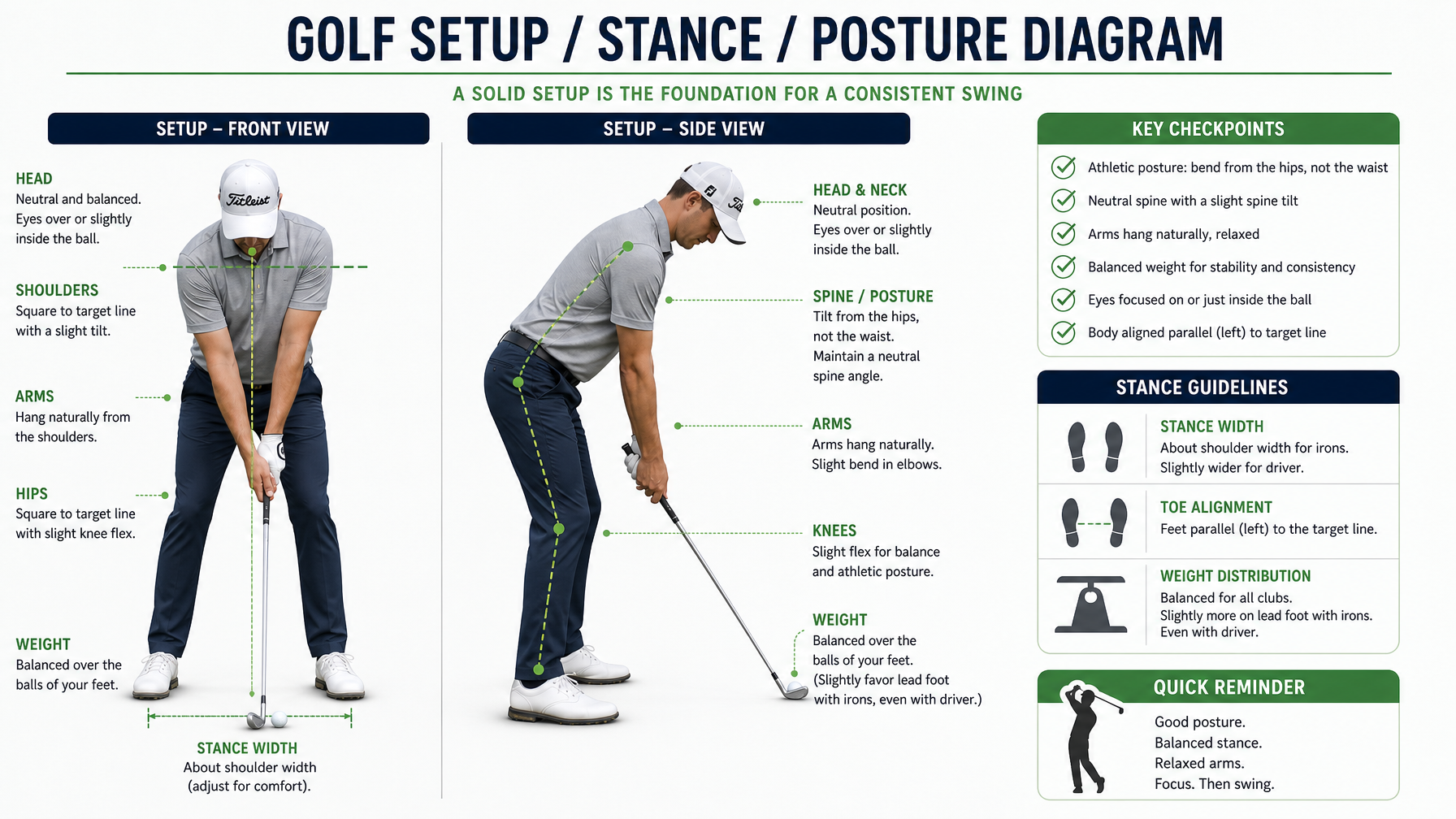
Stance width
- Short irons: Feet just wider than shoulder width.
- Mid/long irons: Slightly wider than short irons.
- Driver: Widest stance just outside shoulder width for stability.
Ball position
- Short irons: Slightly forward of center.
- Mid irons: About 1–2 balls forward of center.
- Driver: Inside the lead heel.
Alignment
- Feet, hips, and shoulders: Parallel to your target line (like train tracks).
- Clubface: Aimed at your actual target.
Quick check: Lay a club on the ground along your toes and another along the target line. They should be parallel, not pointing at the same spot.
If you want to learn how setup changes when hitting a driver, read our guide on how to swing a driver.
3. Golf posture basics
Good posture lets you turn, rotate, and deliver the club without compensations.
Posture checklist
- Athletic stance: Slight knee flex, weight in the balls of your feet, not your heels.
- Hip hinge: Bend from the hips, not the waist. Imagine pushing your butt slightly back while keeping your back relatively straight.
- Spine tilt: Slight tilt away from the target with the driver; more neutral with irons.
- Arms: Hanging naturally from your shoulders, not reaching or cramped.
Common fault: Standing too upright or slouching leads to inconsistent contact and makes it harder to rotate around your spine.
4. Takeaway basics
The takeaway sets the tone for the entire swing. A smooth, connected start makes everything easier.
Simple takeaway keys
- One-piece start: Club, hands, and chest move away together for the first few inches.
- Clubhead path: Club stays roughly along the target line or just slightly inside it.
- Face control: Leading edge of the club roughly matches your spine angle, not wide open or shut.
Red flag: Snatching the club inside with just the hands or rolling the face open early often leads to slices and inconsistent contact.
5. Backswing basics
The backswing is about creating a loaded, balanced position, not about getting as far back as possible.
Backswing fundamentals
- Turn, don’t sway: Rotate your chest and hips around your spine instead of sliding off the ball.
- Weight shift: Slightly more pressure into your trail foot, but still balanced, not all the way to the outside of the foot.
- Lead arm: Relatively straight but not locked; trail arm folds naturally.
- Top position: Club roughly over your trail shoulder, not way across the line or laid off.
Key feel: You should feel coiled and stable at the top, not stretched, off-balance, or swaying away from the target.
6. Downswing and impact basics
The downswing is where everything comes together. Good players don’t just “hit at the ball”, they sequence from the ground up.
Downswing sequence
- Lower body starts: Pressure shifts toward the lead foot as your hips begin to rotate toward the target.
- Chest follows: Upper body and arms follow the lower body, not the other way around.
- Club shallows: The club works slightly from the inside, not steep and over the top.
Impact fundamentals
- Irons: Hands slightly ahead of the ball, weight mostly on the lead side, ball compressed first, then turf.
- Driver: Ball more forward, spine slightly tilted back, hitting “up” on the ball with a stable base.
- Face control: Clubface roughly square to the target line at impact.
Common issues: Early extension, casting, and over-the-top moves often show up here. (If you struggle with those, check out your specific fault and fix it directly.)
Want to know if YOU have this swing fault?
Upload your swing and the analyzer will show you instantly.
7. Follow-through basics
A balanced finish is a great indicator of a solid, repeatable swing.
Finish position checklist
- Weight: Mostly on your lead foot, trail foot up on the toe.
- Body: Chest facing the target, belt buckle toward the target.
- Balance: You could hold your finish for 2–3 seconds without falling over.
If you’re falling back, spinning out, or losing balance, something earlier in the swing is out of sync.
Common swing faults these basics help fix
- Big slices and blocks caused by poor grip and alignment
- Hooks from an overly strong grip or closed setup
- Fat and thin shots from inconsistent posture and low point control
- Topped shots from early extension and standing up out of the shot
- Weak, high shots from poor rotation and early release
- Inconsistent contact from changing ball position and stance every swing
If your biggest struggles happen with the driver, our full guide on how to swing a driver will help you fix your setup, path, and impact.
Simple drills to ingrain the golf swing basics
You don’t need complicated training aids to build a solid swing. A few simple drills can lock in the fundamentals.
1. Grip and setup mirror drill
Stand in front of a mirror and rehearse your grip, stance, and posture. Check:
- Number of knuckles visible on the lead hand
- Ball position relative to your feet
- Spine tilt and hip hinge
- Alignment of feet, hips, and shoulders
2. One-piece takeaway drill
Set up normally, then rehearse moving the club back to hip height with your chest and arms moving together. The clubhead should stay roughly in line with your hands, not way inside or outside.
3. Feet-together balance drill
Hit short shots with your feet almost together. This forces you to stay balanced, rotate around your spine, and avoid big sways or lunges.
Common beginner mistakes with golf swing basics
- Skipping fundamentals: Trying “advanced” tips before grip, setup, and posture are solid.
- Over-swinging: Trying to hit too hard instead of making a controlled, balanced motion.
- Changing too many things at once: Focus on one or two basics at a time.
- Ignoring contact: Good basics should lead to more centered strikes—pay attention to where you’re hitting on the face.
Golf swing basics FAQ
What is the most important basic in the golf swing?
For most golfers, the biggest wins come from a solid grip and setup. If you hold the club well and stand to the ball correctly, the rest of the swing becomes much easier to fix.
How long does it take to learn the basic golf swing?
You can understand the basics in a single session, but building a consistent, repeatable swing usually takes weeks or months of focused practice. The key is to work on one or two fundamentals at a time instead of chasing random tips.
Should beginners focus on distance or contact?
Contact first, distance second. When you start hitting the ball more solidly in the center of the face, distance will naturally improve without swinging harder.
Can I build a good swing without lessons?
Yes, especially if you focus on fundamentals like grip, setup, posture, and balance. But getting feedback whether from a coach, video, or a swing analysis tool can speed up your progress dramatically.
Next step: Check your basics with a swing analysis
Reading about golf swing basics is a great start but the fastest way to improve is to see what your swing is actually doing.
Upload a quick swing video and get instant feedback on your:
- Posture and setup
- Rotation and sway
- Early extension or casting
- Impact position and balance
Click here to analyze your swing now and turn these basics into real, on-course results.